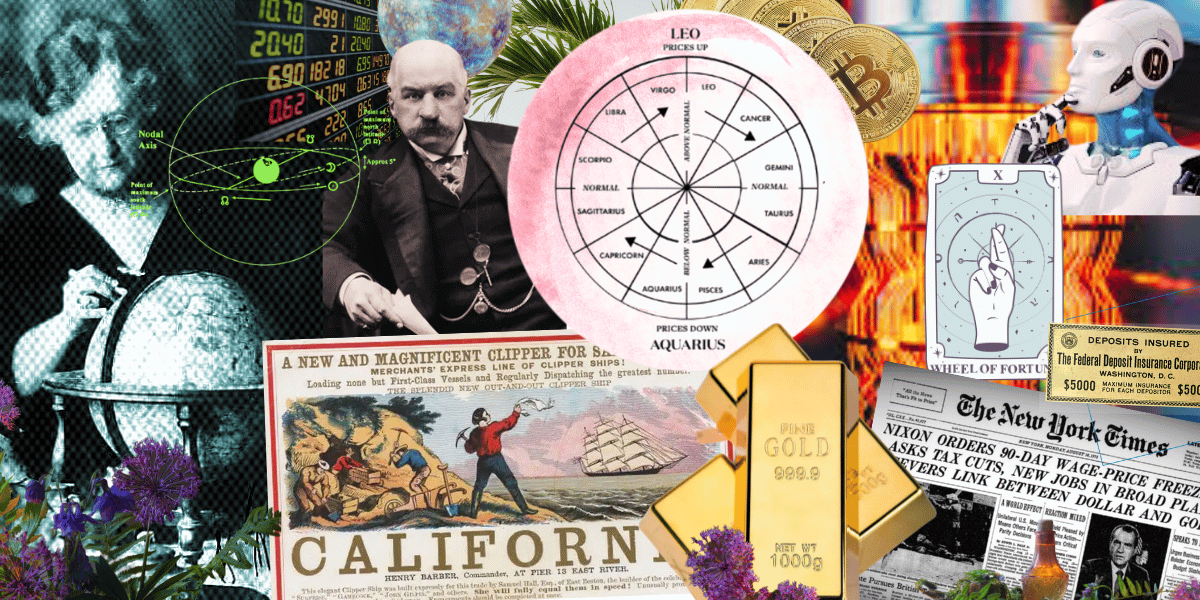
What really moves the markets? Data and algorithms? Human emotion? Or something older—perhaps even cosmic? Maybe it’s all of the above. All about how the lunar nodes shape the economy, financial cycles and astrology.
The following is excerpted from The AstroTwins 2026 Horoscope book. You can also hear Ophira Edut from The AstroTwins discuss financial astrology trends in the videos throughout this post.
Watch: AstroTwins Ophira Edut on Leo-Aquarius Node Cycles in Financial History (1600-2026)
Financial Astrology Predictions: Lunar Nodes 2026
Where We Are, Where We’ve Been
As the world races into the second half of the decade, artificial intelligence dominates headlines. Stock valuations for the “Magnificent Seven”—Alphabet, Amazon, Apple, Meta, Microsoft, Nvidia and Tesla—have soared to heights no one could have imagined a decade ago. But underneath the exuberance, the same question lingers: How long can this expansion last?
Astrologically, that question couldn’t be timelier: On July 26, 2026, the lunar North Node shifts into Aquarius for the first time since 2009, repeating an 18.6-year cycle that astrologers have long associated with the rhythm of prosperity and contraction.
In her 1938 book Astrology and Stock Market Forecasting, astrologer Louise McWhirter proposed that the North Node—the point where the moon’s orbit crosses the Sun’s path—correlates with recurring financial cycles. When the North Node travels through Leo, optimism reigns, confidence inflates and speculative bubbles expand. When it moves into Aquarius, that energy reverses. The market resets, often through crisis or reform.
The Leo–Aquarius Pendulum: Progress Inhale, Exhale
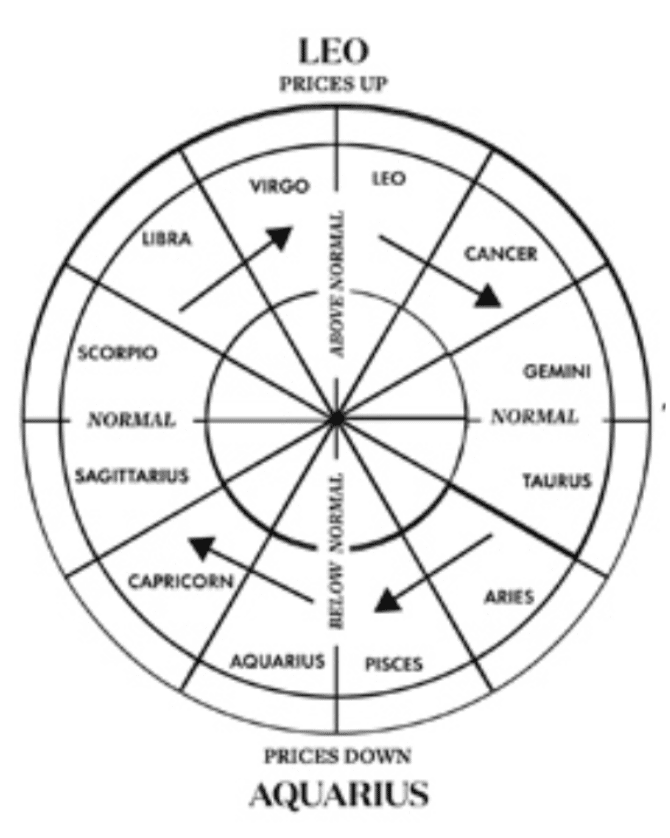
This celestial pendulum between the North Node in Leo and Aquarius has marked nearly every major boom-and-bust moment of the last century. As the North Node approaches Aquarius in 2026, it could bring another round of reckoning—an era of correction and restructuring that lasts until 2028. The question is: What kind of reset will it be this time?
To understand what’s ahead, it helps to look back. Each Leo-Aquarius opposition marks one full inhale and exhale of progress: Expansion and exuberance followed by contraction and reform. Over the past century, this rhythm has shown up with uncanny precision.
Examples of financial cycles in astrology: The Roaring Twenties (Leo) were followed by the Great Depression (Aquarius). The Space Race optimism of the early 1960s (Leo) was followed by Nixon’s 1971 “gold shock” (Aquarius). The dot-com mania of the late 1990s (Leo) crashed into the Great Recession of 2007–09 (Aquarius). The crypto bubble of 2017–18 (Leo) now meets the AI boom of 2025, another potential turning point as the North Node swings into Aquarius.
2026 to 2028: The Aquarian Reset and the Great Compression
As we approach the North Node’s move into Aquarius on July 26, AI has become the engine of speculative mania. On October 29, 2025, the exact anniversary of the 1929 Wall Street crash, chipmaker Nvidia reached an unprecedented $5 trillion valuation, becoming the most valuable company on Earth. Simultaneously, whispers of an AI bubble began to spread. In late 2025, U.S. bank reserves dropped to a $2.8 trillion low, and the Federal Reserve quietly flooded the U.S. banking system with $125 billion over just five days, a move known as “stealth easing.”
Meanwhile, the world’s monetary system is morphing again. Cryptocurrencies, once fringe, are dividing into two camps: government-backed “stablecoins” and decentralized platforms. One example, Worldcoin (co-founded by OpenAI’s Sam Altman), combines digital currency with biometric identity verification. It promises inclusion but raises deep concerns about surveillance and data ownership—issues that feel distinctly Aquarian.
The Great Compression. If the 1930s brought social safety nets and the 2000s created the digital economy, this upcoming cycle could deliver what might be called The Great Compression. Everything—information, power and wealth—is being condensed into tighter, faster, more centralized systems.
As the Aquarius North Node returns from July 26, 2026 to March 26, 2028, new forms of regulation are likely to emerge—not for banks this time, but for algorithms, digital currencies and energy use. Governments may impose guardrails around AI ethics, data privacy and the environmental cost of technology. The drive to power vast AI systems may push innovation in nuclear and renewable energy, reviving debates about safety, waste and control.
Watch: Ophira Edut on Helena Woods Podcast talking financial astrology
The Prophets of Prosperity: Wall Street’s astrologers and spiritual advisors, and the financiers who backed them
Financial cycles and astrology isn’t a new concept. Astrology’s connection to finance isn’t new. Long before Louise McWhirter, mystics were mapping the skies for signs of market movement. In 1870, Victoria Woodhull and her sister Tennessee Claflin (both Spiritualists) opened Wall Street’s first female-run brokerage, backed by railroad tycoon Cornelius Vanderbilt. Their psychic abilities and boldness made them wealthy and infamous.
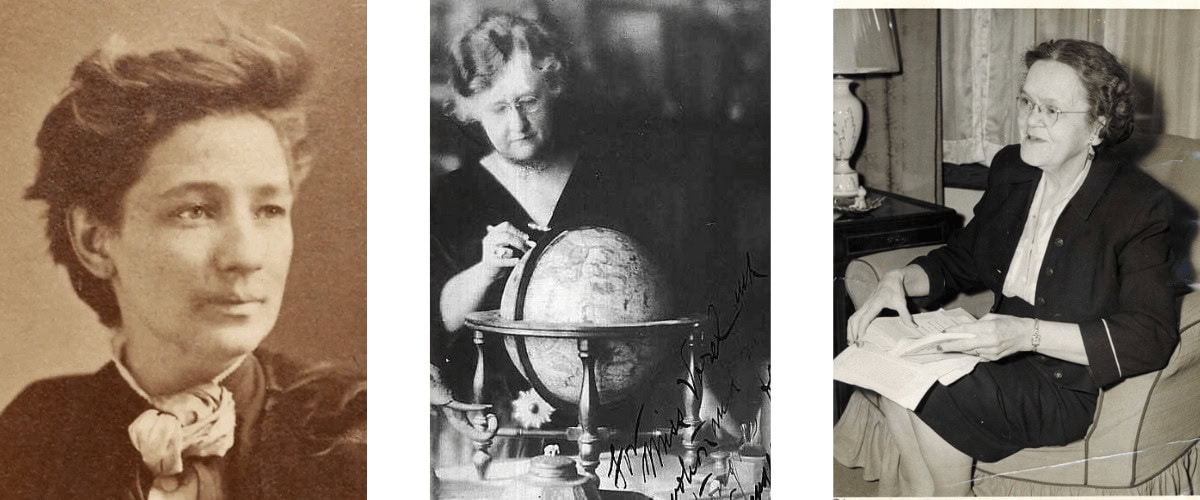
L-R: Victoria Woodhull, Evangeline Adams, Louise McWhirter
A generation later, Evangeline Adams, dubbed “America’s first astrological superstar,” read charts for financiers including J.P. Morgan. She was tried three times for fortune-telling and acquitted each time, famously impressing a judge by predicting his son’s fate through astrology.
The apocryphal line ‘Millionaires don’t use astrology; billionaires do’ is often attributed to J.P. Morgan.
In the early 20th century, trader W.D. Gann merged mathematics and astrology, charting planetary cycles against stock prices. He claimed that “when time and price become equal, the market must reverse.” His methods prefigured modern technical analysis and introduced the idea that markets move in natural, geometric rhythms.
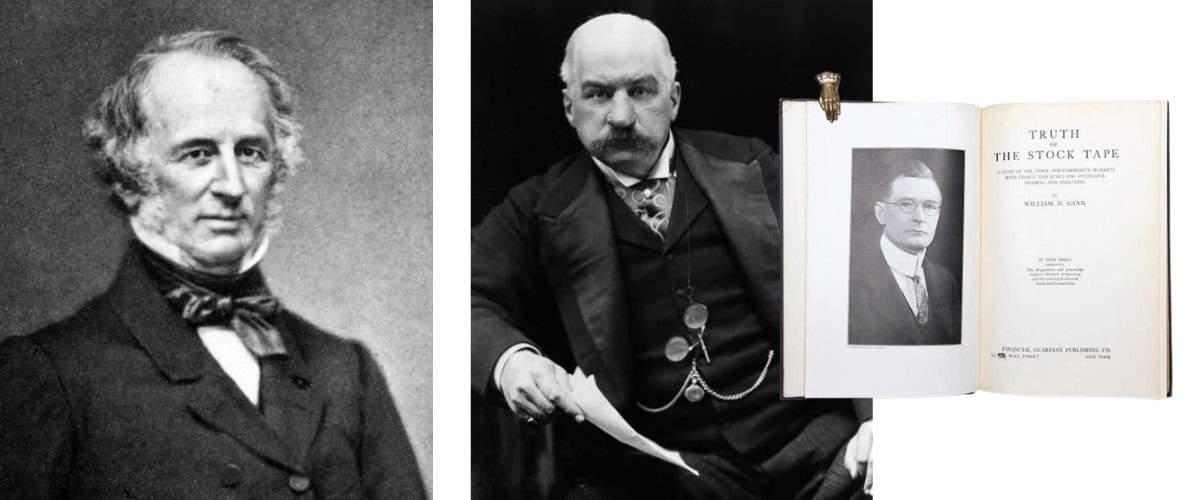
L-R: Cornelius Vanderbilt, JP Morgan, WD Gann
Even the U.S. Commerce Department brushed against these ideas. In 1931, Chief Economic Analyst Edward R. Dewey was tasked with finding the cause of the Great Depression. His research led him to the study of cycles—solar, agricultural, social—and their astonishing regularity.
Cycles are inevitable. In 1942, under a Leo North Node, Dewey founded the Foundation for the Study of Cycles, documenting thousands of recurring patterns in nature and markets. Among his findings: a 9.2-year rhythm that neatly aligns with half of the lunar nodal period. His book Cycles: The Science of Prediction became a cult classic, later republished with bestselling author Og Mandino. Dewey’s conclusion was simple: Cycles are the invisible architecture of reality.
The 1920s Leo North Node: From Roar to the Floor
In the 1920s, the aptly-named Roaring Twenties brought a Leo North Node cycle from April 23, 1924 to October 26, 1925. True to form, the Big Cat energy inflated the market with jazz-era optimism and opulence. Hope returned after the devastation of World War I, bringing the advent of electricity, radio and motion pictures, appliances and automobiles. Urbanization took hold, as people left farms for industrial jobs, marking the first time in U.S. history that more families lived in cities than in rural areas.
The 1920s also gave birth to consumer credit. With just one household income, the typical family couldn’t afford to buy a car or washing machine. In 1919, General Motors offered the first installment plan, allowing autos to be purchased with a 35 percent downpayment. The idea took off. By the time the North Node entered Leo in the mid-1920s, people were buying everything from appliances to stocks on credit. Debt was marketed as an opportunity to gain wealth and be part of America’s growth—the land of limitless potential.
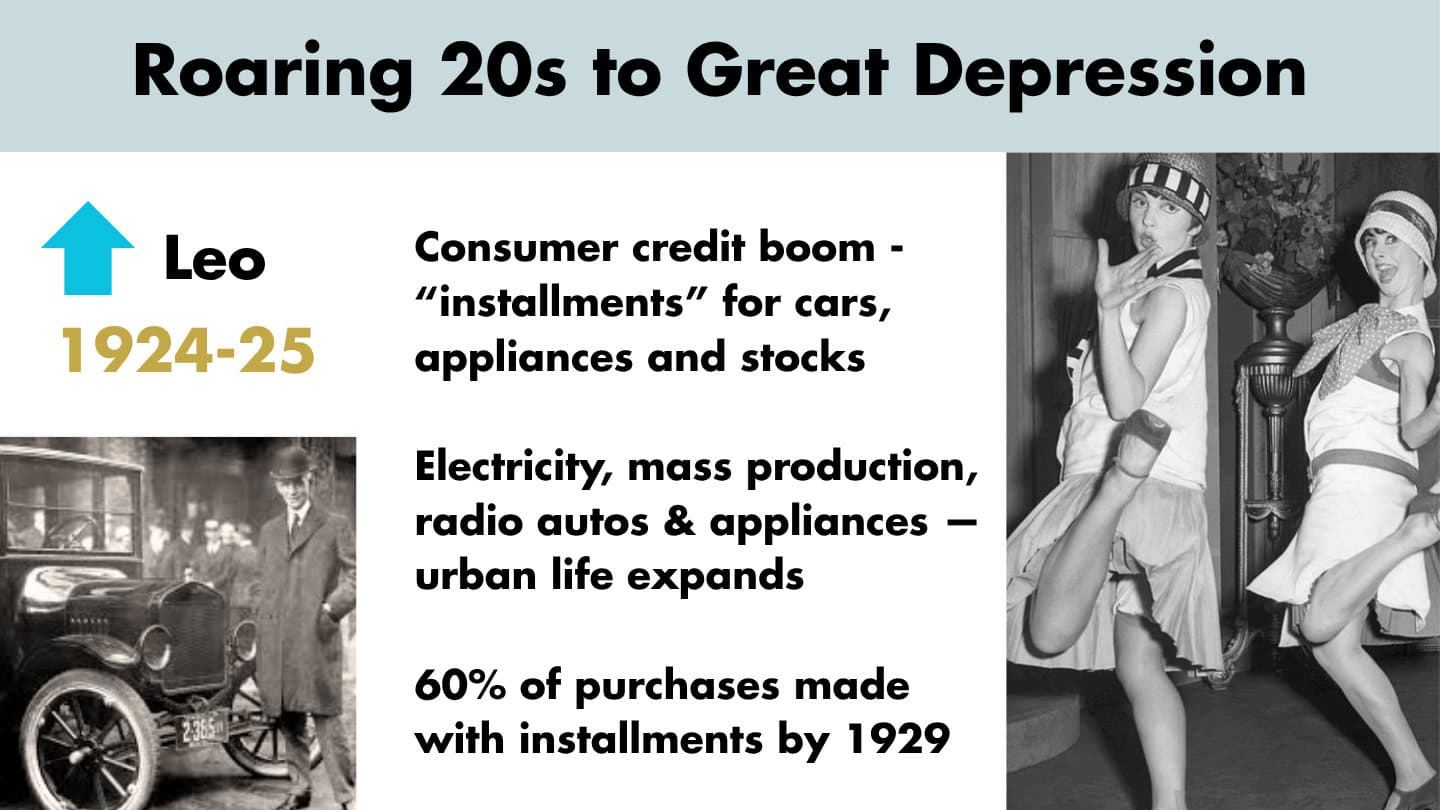
In theory, it was inspiring. But as the 1920s stock market bubble inflated, people began buying stocks on “margin,” sometimes for as little as a 10 percent downpayment. The catch? At the time, banks didn’t have the remaining amount in reserve to cover the 90 percent gap, putting them at risk of failure. When the market dropped, everyday investors would panic, as they had neither the experience nor the extra cash to cover their debts. To pay their loans, they’d sell their shares en masse, sending banks into a spiral. This volatility set the stage for the October 29, 1929, Wall Street crash, which plunged the United States into the Great Depression, and spread into a multinational economic crisis leading up to World War II.
The 1930s Aquarius North Node: Great Depression and The New Deal
The Great Depression lasted from 1929 to 1939, but its low point coincided closely with the bottom of financial astrology’s synodic cycle. The North Node entered Aquarius from June 25, 1933 to March 8, 1935, and it was time for repair.
In 1932, the Dow Jones hit rock bottom. One in four people were unemployed and over 9,000 banks had shuttered. Breadlines stretched for blocks as the hungry waited for meals from churches, charities and local businesses. Many Americans lost their homes and moved to self-constructed shantytowns, dubbed Hoovervilles in contempt of then-President Herbert Hoover (a Leo). The market needed rescuing, and Aquarius Franklin Delano Roosevelt stepped up to do it. In March 1933, three months before the North Node entered Aquarius, Roosevelt was elected U.S. President. He quickly introduced The New Deal, a series of reforms that began to dig America out of its plight.
Recovery began with the Emergency Banking Act on March 9, 1933, which authorized the Federal Reserve to insure bank deposits and offset a potential crash. In June 1933, FDR codified this in the 1933 Banking Act, also known as the Glass-Steagall Act. Signed just one week before the North Node entered Aquarius, the 1933 Banking Act enforced a strict separation between commercial and investment banking. (This same Act would figure prominently in the Leo/Aquarius synodic cycles of both the late 1990s dot-com boom and the 2008 Great Recession.)
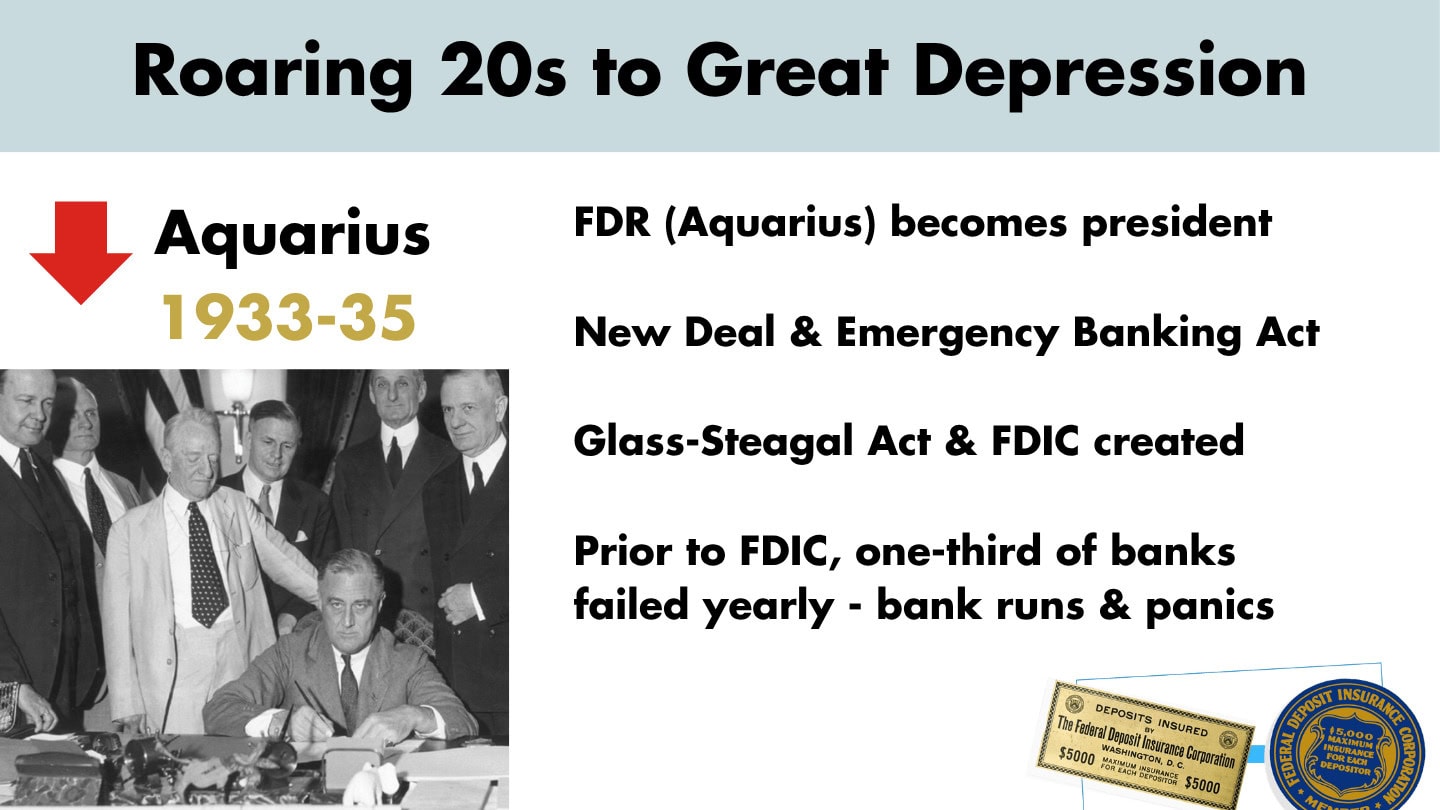
No more bank runs. Glass-Steagall established the Federal Deposit Insurance Corporation (FDIC), offering government-backed insurance to protect bank deposits. Prior to the FDIC, more than a third of banks failed each year, when panicked customers withdrew all their money at once in “bank runs.”
The groundwork for such reform stretched back to earlier nodal swings. The Federal Reserve, founded in late 1913 at the dawn of the 1914-15 Aquarius North Node, had been conceived to prevent the kind of chaos seen during the 1907 Bankers’ Panic—a crash that struck while the North Node was in Leo. That episode saw the market plunge 50 percent, forcing financier J.P. Morgan to personally bail out failing banks. Unfortunately, the Fed was still new when Wall Street crashed in 1929, and was unprepared to mitigate the crisis that led to the Great Depression. Bank deposits were not insured by the Federal Reserve until one full Aquarius Nodal cycle later, when the 1933 Banking Act wrote the FDIC into law.
Social Security. The 1933 to 1935 Aquarius North Node cycle also produced the Social Security Act of 1935, cementing America’s first social safety net—a program now facing its own pressures as the next Aquarius North Node approaches in 2026.
The 1940s Leo North Node: Wartime Boom and Bretton Woods
Franklin Delano Roosevelt was the only U.S. president to serve four terms. His time in office spanned an entire Aquarius–Leo nodal cycle. His first term began in 1933, on the eve of the Aquarius North Node and amid the Great Depression. His fourth ended with his death in 1945, just after the Leo North Node cycle ended, as the nation entered a postwar economic boom.
The North Node was in Leo from November 22, 1942 to May 11, 1944, which were the peak years of World War II. The war, which began on September 1, 1939 and ended on September 2, 1945, mobilized the economy and ended the Great Depression. Although the government went into debt financing the war, the U.S. employment rate surged as people went to work in factories for wartime production. After the war, the economy continued to boom from consumer demand and the GI Bill (signed right after the North Node left Leo), which funded university educations for many veterans.
At the end of World War II, the world’s economies were in chaos—currencies were unstable, trade had collapsed and countries were deep in debt. On July 22, 1944, right after the North Node finished its tour of Leo, leaders from 44 nations came together in Bretton Woods, New Hampshire, to agree on rules for how money and trade would work between countries. The result was the 1944 Bretton Woods Agreement, which pegged world currencies to the U.S. dollar, which was in turn backed by gold. To keep the peace, Bretton Woods delegates created two institutions: the International Monetary Fund (IMF) to steady currencies and lend to struggling nations, and the World Bank, to fund rebuilding and growth.
Here we see a connection from prior synodic cycles between (Leo-ruled) gold and the United States’ position of strength in the gold market. In April 1933, when the North Node was nearing Aquarius, FDR signed an order banning private gold ownership. Americans had to turn in their gold coins, bars and certificates to the Federal Reserve in exchange for paper dollars at about $20 an ounce. By removing gold from the hands of everyday Americans, FDR centralized the nation’s reserves, consolidating power in the U.S. Treasury just as the global economy was preparing for a massive reset.
A decade later, the Bretton Woods Agreement built on that foundation, pegging the world’s major currencies to the U.S. dollar, which itself was backed by gold. In effect, gold still anchored the global economy, but now through the dollar rather than direct ownership, and the United States became the world’s financial axis, around which other currencies now orbited.
The 1970s Aquarius North Node: Nixon Ends Bretton Woods and The Gold Standard
For almost three decades, the Bretton Woods system held the world economy together, giving postwar nations a stable framework for recovery and trade. But by the late 1960s, the arrangement began to crack. The U.S. had printed more dollars than it had gold to back them, partly to fund the Vietnam War and social programs at home. The Fed’s gold reserves were dwindling and other nations started losing faith in the dollar’s promise.
Nixon shock. In August 1971, with the North Node in Aquarius (November 3, 1970 to April 27, 1972), President Nixon officially ended Bretton Woods. Foreign governments could no longer exchange their U.S. Dollars for gold, silver or other reserves. Overnight and without warning, money became fully “fiat.” Rather than being insured by a tangible item like gold, the U.S. Dollar was now backed by something much harder to quantify: the public’s trust in its current government and the perceived strength of the market. While the Dow Jones initially shot up and it won Nixon a reelection, his surprise move became known as “Nixon shock.”
The biggest change from this nodal reset? Interest rates, which were determined by the current market value of gold, changed from fixed to flexible, determined by fluctuating market forces. To this day, Nixon’s 1970s Aquarius North Node policies—and his stunning end of the gold standard—shape how the entire world economy operates.
The 1980s Leo North Node:
Stagflation and Reaganomics
The 1980s Leo North Node began under harsh economic skies—but with optimism puffed up like the decade’s signature shoulder pads. During the Leo North Node period that spanned from January 6, 1980 to September 24, 1981, the world experienced another serious recession. It arrived on the heels of the 1979 Iranian Revolution, which caused oil prices to surge and created a global energy crisis. The United States experienced stagflation, a double hit of high inflation and widespread unemployment happening at once.
Despite this turbulence, the cycle was still marked by the Leo North Node’s trademark (and sometimes self-deluding) optimism. Ronald Reagan rose to power, elected in November 1980 and inaugurated in January 1981. His charisma and Hollywood roots were quintessential Leo, and his brand of Reaganomics (lower taxes, less regulations on corporations and financial institutions) exuded Leo bravado.
The 1980 Deregulation Act loosened banking rules and expanded financial institutions’ lending powers. This fueled more risky speculation, especially in real estate. Gold made a comeback, hitting a record high of $850 per ounce as investors shifted away from fiat currency into tangible assets.
In June 1980, CNN launched, ushering in the 24-hour news cycle and a culture of constant visibility, on brand with showy, dramatic Leo. This was also the dawn of the personal computer revolution. Apple went public in December 1980; the next year, Steve Jobs took over Apple’s Macintosh project and IBM released its first PC.
Behind the Leo-era optimism, the reality was far darker. By mid-1982, bank failures reached their highest level since the Great Depression, forcing the FDIC to spend nearly $870 million covering bad loans. It marked the dawn of a new boom-and-bust era—fueled by deregulation and overconfidence—that would echo through future cycles.
The 1999-2000 Leo North Node:
Dot-com Bubble, Banking Act Repealed
New gold rush. When the North Node returned to Leo in the late 1990s, the world entered another glittering gold rush, this time online. The dot-com boom surged, as tech founders became “paper millionaires,” bloated with venture capital financing and overvalued stock options.
Rolling back. In 1999, President Bill Clinton, a Leo, signed the Gramm-Leach-Bliley Act, which repealed key regulations of the 1933 Glass-Steagall Act—the protective 1933 Banking Act signed by FDR during the Aquarius North Node cycle. This move erased the long-standing barriers between commercial and investment banking, and set the stage for the 2008 Great Recession.
By stripping away key safeguards, deregulation fueled reckless risk-taking and birthed the era of “too big to fail” (TBTF) institutions. In 2010, Fed Chair Ben Bernanke defined a TBTF firm as one so large and interconnected that its collapse could trigger severe damage across the entire financial system. Once again, the speculation and risk-taking of past Leo North Node eras played out on a grand scale.
By 2000, the dot-com bubble burst and markets crashed—but the internet remained, permanently transforming how humans connect. Dial-up internet (“You’ve got Mail!”) gave way to broadband, Wi-Fi and the first smartphones, turning the web from a static information source into a living network. In true Leo fashion, everyone suddenly had a stage, and the world was learning how to perform online.
The Great Recession of 2008:
Aquarius North Node Strikes Again
The Aquarius North Node returned from December 2007 to August 2009, ushering in the Great Recession. The U.S. housing collapse triggered a global subprime mortgage crisis, while Bernie Madoff’s 2008 Ponzi scheme, exposed under this same transit, erased an estimated $64 billion in client wealth.
Mortgage upheaval. Few companies mirrored the North Node’s Leo-to-Aquarius arc more closely than Lehman Brothers. When the bubble burst under the 2008 Aquarius North Node, Lehman was the world’s largest subprime mortgage lender, a position that they’d built up to since the 1999 Leo North Node deregulations.
Because the 1999 Gramm-Leach-Bliley Act removed guardrails between commercial and investment banking, Lehman Brothers was able to pursue riskier ventures like subprime mortgages, and to use complex math that masked their debt-fueled expansion. While the late-90s Leo North Node boosted Lehman’s profits, it also left the firm overexposed to risk, setting the stage for its 2008 Aquarius North Node collapse.
In the first half of 2008, Lehman’s stock lost half its value. Its $680 billion of assets were supported by only $22.5 billion of firm capital, a huge disparity. Even after receiving over $150 billion of “Federal Reserve-backed advances” from JPMorgan Chase in September 2008, Lehman Brothers ultimately filed for bankruptcy. As we’ve seen, Aquarius North Node crashes also bring corrective measures. In November 2008, Barack Obama, a Leo whose birth chart features a Leo North Node, was elected U.S. President in November 2008, inheriting the worst economic climate since the Great Depression.
In February 2009, right after his inauguration, President Obama (Leo) signed the American Recovery and Reinvestment Act (ARRA), a nearly $800 billion stimulus package. Much like FDR’s 1933 Emergency Banking Act, the ARRA took immediate action, bailing out the Big 3 automakers and creating the Home Affordable Refinancing Program (HARP) to save homeowners from defaulting on their mortgages and losing their properties to foreclosure.
The Aquarius North Node cycle once again brought legislation that could be up for review in 2026 to 2028. In 2010, the Dodd-Frank Wall Street Reform and Consumer Protection Act (known as Dodd-Frank) was signed into federal law. Among its reforms, Dodd-Frank strengthened consumer protections against predatory credit, mortgage and loan practices. It demanded greater transparency from financial institutions, enhanced shareholder oversight and shielded taxpayers from footing the bill for future corporate bailouts.
While the government was protecting U.S. citizens, the last Aquarius North Node cycle paved the way for fintech and decentralized digital currencies such as Bitcoin, which was first minted on January 3, 2009, during this Aquarius North Node cycle. Amid the 2008-09 Aquarius North Node crash and correction cycle, interest in decentralized finance and digital currency grew. On October 31, 2008, the elusive Satoshi Nakamoto released the Bitcoin white paper, a digital manifesto that introduced cryptocurrency—and a new vision of money—to the world.
In the years that followed, a quiet revolution brewed. By 2010, Bitcoin had real-world value (one early user famously traded ten thousand coins for two pizzas, a move they undoubtedly regret). Blockchain technology expanded beyond currency into contracts, art and data systems. As trust in traditional banks waned and smartphones connected the globe, digital assets began to feel inevitable.
2017 to 2018 Leo North Node:
The Cryptocurrency Bubble
By the time the Leo North Node returned from May 10, 2017 to November 6, 2018, speculation soared once again. This time, it wasn’t over dot-com stocks and IPOs, but rather, crypto coins and ICOs.
These two years marked the first cryptocurrency bubble, as the market exploded from $16 billion to $535 billion. Some investors hailed crypto as the future of finance, while others dismissed it as a fad. As the Leo North Node reached its peak, digital currency entered the mainstream, drawing the attention of regulators and institutional investors alike.
A brief crash came when Bitcoin dropped from almost $20,000 a share in late 2017 to around $3,000 by the end of 2018. Although the market lost $400 billion, it allowed new investors to “buy the dip,” and crypto went mainstream. Millions of people first heard of Bitcoin, Ethereum and blockchain, and began buying on crypto exchanges.
On the downside, this era spawned overpriced NFTs and the rise of the “crypto bro.” Yet it also offered working people and marginalized communities a rare shot at generational wealth. The high-risk optimism mirrored the Leo North Node cycle of the 1920s—an age of consumer credit and installment dreams. As before, a few struck it rich, but most didn’t. Whether buying stocks on margin in the 1920s or overvalued NFTs in the 2020s, many fell prey to the same glittering illusion.
A table of the financial cycles in astrology for the Leo-Aquarius lunar nodes, from 1905 to 2028, appears on p. 616 of The AstroTwins’ 2026 Horoscope book.
Financial Cycles and Astrology: Where Do We Go From Here?
As the North Node enters Aquarius on July 26, 2026, humanity faces another inflection point. What we learn in this next phase could define the century: whether AI becomes an instrument of progress or exploitation; whether currency evolves into a tool for inclusion or control; whether we treat the coming contraction as collapse or as evolution.
History suggests that every downturn is also a dawn. The 1930s birthed modern social systems, the 1970s reshaped global finance and the 2000s gave us digital innovation. As we enter the communal Aquarian Age, and the next Aquarius North Node cycle, perhaps the wisest investment we can make is in humanity’s shared survival.
Follow your free daily horoscope from The AstroTwins to never miss an important detail!
Our new podcast is here!
AstroTwins Radio
Subscribe and join us every week wherever you get your podcasts!
Listen here

What are the lunar nodes? In astrology, your life purpose is encoded in the North and South Nodes of the moon. They aren’t planets, but rather mathematical points that fall in two opposite zodiac signs: Aries/Libra, Taurus/Scorpio, Gemini/Sagittarius, Cancer/Capricorn, Leo/Aquarius, Virgo/Pisces.
With their 18-month cycles, the lunar nodes show where destiny calls and where you must release your outmoded ways. The North Node points to growth. The South Node guides where to let go. Depending on which zodiac signs the lunar nodes are visiting (or where they are in your birth chart), plan for: karmic shifts, major life changes and alignment with your higher purpose.